
Model-controlled processes vs agentic AI: What product leaders must know in 2025
Model-controlled vs agentic AI: what’s the real difference, and why does it matter for product success? Learn how product leaders can make smarter AI decisions in 2025.

Model-controlled vs agentic AI: what’s the real difference, and why does it matter for product success? Learn how product leaders can make smarter AI decisions in 2025.

AI isn’t replacing UX researchers—it’s making them faster, sharper, and more focused on what matters. In this article, we explore how AI in UX research is transforming workflows by speeding up transcription, synthesis, and insight discovery, without losing the human intuition that great research demands.

AI agents in SaaS are quietly dismantling the monolithic software suite. From GitHub to IBM, enterprise software is shifting from feature-rich platforms to autonomous, outcome-driven agents. Here’s what product teams need to know now.

AI agent onboarding is now a critical part of product design. This article breaks down what SaaS teams need to know to successfully onboard autonomous AI agents—from defining their role and permissions to designing agent-friendly interfaces and training them to enhance usability, not break it. Thoughtful onboarding improves adoption, reduces churn, and turns AI into a strategic asset—not a UX liability.

UX design is entering a new era: one where AI agents — not humans — are the users. This article explores what product teams need to know to design systems that support autonomous AI agents, from API clarity and structured data to explainability and agent-aware UX tooling. The next 12 months will define how well we adapt.

AI-assisted design workflows help product teams iterate faster, explore more concepts, and focus on high-value work. This article breaks down what those workflows look like in practice—real tools, tradeoffs, and how to adopt AI without losing creativity or control.

Product leaders don’t have to wait for full-blown AI agents to start transforming their workflows. With MCP, they can begin building intelligent, semi-autonomous systems right now. Here’s how to start.

Designing systems for AI agents—your new digital colleagues—requires more than APIs and data. It demands a new kind of user experience thinking: Agent-Based Experience (AX). In this article, we explore the pillars of AX, from structured data and explainability to agent onboarding and recovery loops, helping teams future-proof their products and create seamless human–agent collaboration.

As AI takes a bigger role in decision-making, the missing piece in many products is empathy. This piece unpacks how UX design for AI products can either erode or earn user trust — and why empathy is the key to building better, more human-centered systems.

SaaS is evolving — from subscription-only to usage-based, modular, and AI-native models. Product leaders must rethink UX as a business strategy, not just an interface layer. This article offers key UX strategies to help SaaS companies reduce churn, build trust, and thrive in an era of rapid transformation.
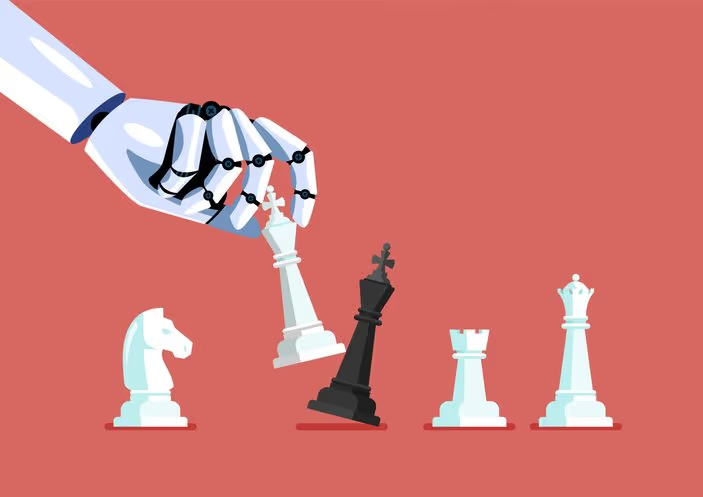
What does it really mean to practice UX design with AI at the core? This article breaks down how AI for UX strategy is changing the game for product leaders, speeding up research, deepening insights, and driving smarter design decisions without losing sight of ethics or user trust.

AI is quietly becoming your team’s most efficient project collaborator. But integrating it isn’t just about saving time—it’s about redefining how product teams manage context, collaboration, and complexity. This guide to AI project management for product teams lays out the tools, challenges, and cultural shifts shaping the next era of work.

Great conversational AI doesn’t start with tools — it starts with conversation. This article explores how analog-first methods like intent cards, role-playing, and storyboarding create more natural, human-centered AI experiences that are easier to implement and more enjoyable for users.
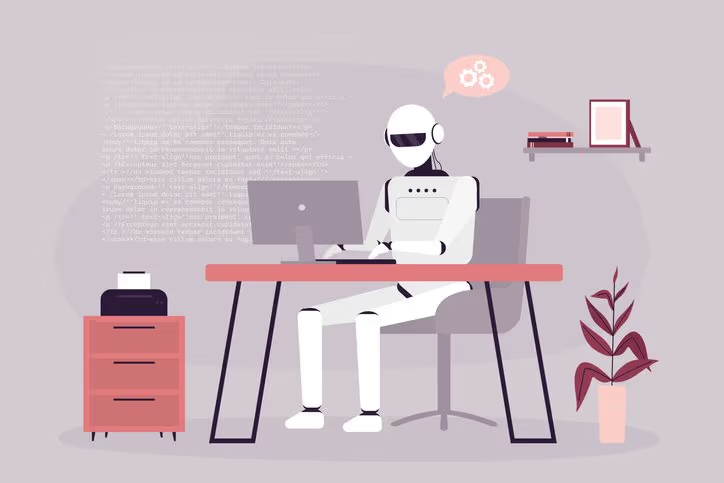
UX is no longer just for users — it’s for the AI agents acting on their behalf. This article explores agent-based experience design (AX): what it is, why it matters, and how designers and product leaders can prepare for a future shaped by autonomous agents.

Agentic AI refers to intelligent systems that operate independently, make decisions, and adapt in real time without constant human oversight. Unlike traditional AI that reacts to prompts, agentic AI sets its own goals and carries them out—making it a transformative force for industries like cybersecurity, software development, and operations.

Standard Beagle is an AI UX agency based in Austin, TX. We help B2B SaaS and health tech companies create better product experiences with smart strategy, user-first research, and ethical AI workflows.


AI-Generated Interfaces Are Shipping Fast. UX Isn’t.
What product leaders need to know for 2026.